
Experimental and modelling approach for fatigue life prediction of anisotropic metallic materials based on indentation-derived parameters

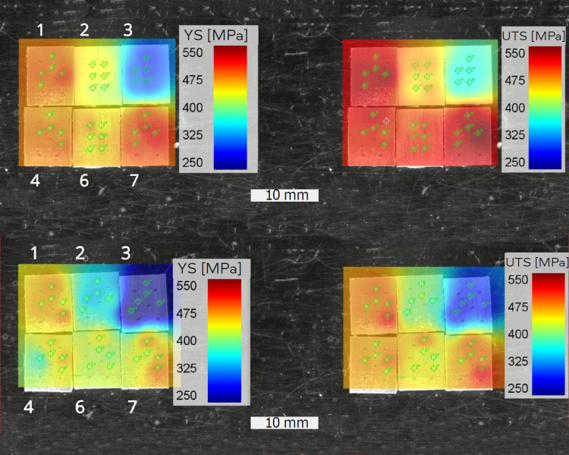
The mechanical behavior of metallic materials is conventionally characterized by stress-strain curves obtained from tensile tests, which form the basis for determining key material parameters and subsequent fatigue life prediction. However, these tests require extensive specimen preparation, are difficult to automate, and are often not applicable to complex geometries or locally varying material states. Indentation-based testing combined with finite element (FE) simulation already enables the determination of tensile properties in a more efficient and localized manner, but its current application is limited to isotropic materials. The aim of this project is to extend this approach to anisotropic metallic materials and to establish an experimentally based framework that links indentation-derived material parameters with fatigue life modeling. To this end, direction-dependent mechanical properties and microstructural characteristics of three material systems, extruded aluminum, selectively laser-melted steel, and a highly deformed deep-drawing steel, are investigated and used to develop and validate a fatigue life model that accounts for anisotropy and critical defect size. These experimentally derived models are integrated into an FE-based digital twin of the indentation process, enabling the identification of material parameters and the estimation of lifetime-relevant properties from localized indentation measurements. The project provides a methodology for transferring indentation data into model-based fatigue assessments, forming the basis for automated and resource-efficient material testing of anisotropic materials.
Duration: 2025 until 2027