
Cotto4Cut: The effect of different cutting technologies on the edge crack sensitivity and fatigue behavior of the cellulose-based material Cottonid





The depletion of finite resources and climate change are major consequences of industrialization and create an urgent need for new approaches to sustainable materials. Since industrial processes and products consume large amounts of resources and energy, new developments in this area can make a significant contribution to increasing sustainability in engineering. Furthermore, the recyclability of the resources used—both during production and at the end of a product’s life cycle—is a key factor in reducing the environmental impacts associated with non-biodegradable and environmentally harmful materials.
Cellulose-based biocomposites represent a promising class of materials for addressing these challenges. Cottonid is a fully cellulose-based biocomposite that was patented even before industrialization as the first modified natural material. Due to its physical and mechanical similarities to engineering plastics and lightweight metals (e.g., aluminum), Cottonid possesses high technological potential. The material has been known since the 19th century and was primarily used as a construction and packaging material. At the beginning of the 20th century, however, it was replaced by synthetic plastics in most technical applications and is now found predominantly in niche applications.
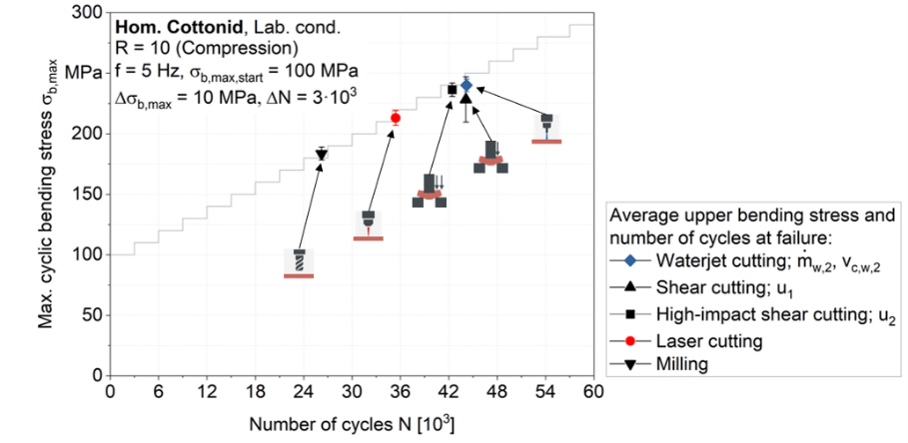
Application-oriented research is needed to tap into the market potential of this promising material. To date, studies have not been conducted, among other things, on how different cutting technologies affect the edge quality of Cottonid components and, consequently, crack initiation, crack propagation, and mechanical behavior. Possible cutting technologies include, for example, shear cutting (the most cost-effective and most widely used industrial method), laser cutting (with thermal effects), and waterjet cutting (without thermal effects).
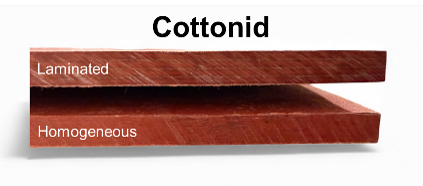
Milling was selected as the reference technology in this research project. Cottonid specimens produced by different cutting technologies were used to generate characteristic values for quasi-static and cyclic loads in order to comparatively evaluate the effects of the cutting technologies on the mechanical performance of two Cottonid materials—homogeneous and laminated Cottonid. The laminated material offers process-related advantages in terms of energy, time, and cost efficiency.
Duration: 2024 until 2026