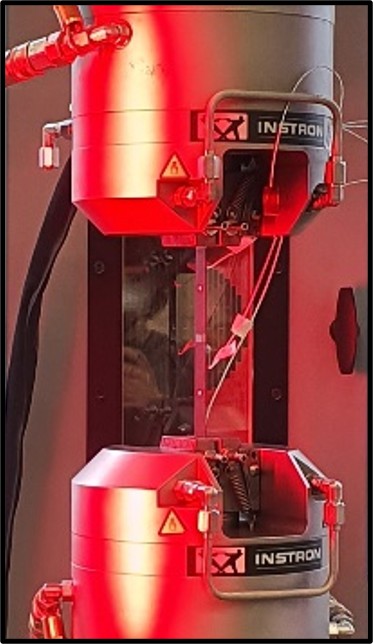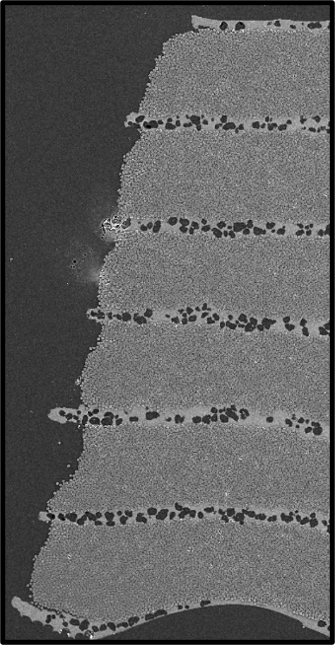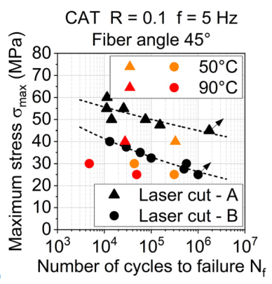


Fiber-reinforced plastics are well-suited for lightweight structures with properties tailored to applied local loads due to their high specific strength, flexible choice of components, and layer arrangement. In addition to the manufacture of fiber-reinforced plastics, cutting is an important processing step that influences the mechanical properties of the component. In addition to conventional cutting methods (milling, sawing), waterjet cutting is a well-established technique. Unlike laser cutting, however, waterjet cutting is subject to tool wear, is poorly suited for complex geometries, and is limited in speed. All cutting methods cause damage in the area of the cutting edge (edge region), and their impact on the mechanical properties must be understood. The influence of the cut quality (laminate edge effect, fiber-matrix adhesion) is particularly significant in fatigue testing. Taking into account the findings already obtained during the first funding period and the increased damage development originating from the edge region due to laser beam cutting, a simulation-based service life prediction will be developed in funding period 2. This will involve analyzing loading scenarios with maximum stress in the edge region (tensile, compressive, and bending fatigue).
Duration: 2026 until 2028